Cindy Truong
Creative Writing
2025 | Naya Magazine 'In Conversation With Cindy Truong On Poetry, Memory and ‘Spring Knows No Daughter’'
2024 | West 10th 'White Swallow'
2024 | Baedeker Spring ‘24 NYC 'Vietnam in Vignettes'
2023 | Generasian Magazine: Renew 'Mouthful & 'Body of Water'
2022 | Generasian Magazine: Roots 'Gingerly'
2022 | Generasian Blog 'The Season of Us'
2021 | MAD Times: Sol Sistere, Issue 2 'Fish Under Ice'
2021 | MAD Times: Culture Shock, Issue 1 'Cover Up' & 'Jet Lag'
Copywriting
2024 | Authority Magazine 'Leading with Heart: Kathryn Landis On The Power of Authentic Women’s Leadership'
Secured a written interview feature through a compelling editorial pitch; copyedited interview content provided by interviewee to align with publication standards and tone
2024 | Kathryn Landis Consulting 'Problems with Gen Z in the workplace? Here’s how to bridge the gap'
Enhanced SEO presence by integrating strategic keywords; copyedited for grammar, clarity, and formatting consistency
2024 | NYU KNESIS Weekly Newsletter
Formatted and wrote weekly content; maintained consistent tone and branding while delivering timely K-pop industry news and community updates
2023 | NYU Vietnamese Student Association November Newsletter
Formatted and wrote biweekly newsletter featuring upcoming events and community updates, using inclusive language to promote Vietnamese culture within the student body
2023 | NYU Vietnamese Student Association VSA Visionary Volume 1
Produced a monthly newsletter focused on curated recommendations and interests from board members alongside community event highlights
Journalism
2026 | EnVi Media 'Ocean Vuong Has a Hartford Homecoming With Photo Exhibit "I'm Sorry I Love You"'
2026 | EnVi Media 'DOAN Atelier Dresses Folklore: Nàng Gấm and the Language of Silk'
2026 | EnVi Media 'Pyper Bleu on Building a Creative Village'
2026 | EnVi Media 'Here She Comes: Olivia Cheng Joins the Deadly Game of "Ready or Not 2"'
2026 | EnVi Media 'Be Vietnamese for One Day at "Phở With Phriends"'
2026 | EnVi Media 'From Bangkok to New York: Thai Designers VICKTEERUT, Landmeé, TAKARA WONG Studios, and SARRAN Take it "Up to the Sky" With NYFW Showcase'
2025 | Bite Club 'Add Me On Beli?'
2024 | Bite Club 'Best Rainy Day Eats In LES'
Media
Contact

Cindy Truong is a New York-based writer and communications creative working across cultural journalism, brand storytelling, and media production.Her work centers on culture, entertainment, art, and the Asian diaspora through narrative-driven reporting and editorial features.She currently contributes to editorial and event coverage for EnVi Media with additional experience in public relations and strategic communications.
Let's Get in Touch!
White Swallow
Published in West 10th (2024)
At fourteen, she quits the circus act.
Begins her tantalizing song. She says
I want to be like Edith Piaf.Somewhere in a muggy Saigon cabaret.
A radio plays the French children’s program.
Bạch Yến in Paris
Sings her alphabetical ballad.
The parroting shouts of street vendors.Her feather boa hangs
around her pale neck.
She serenades along
grenade high notes.Say yêu anh. Yêu anh.
Yêu, yêu, yêu anh.
Say, sweetheart, the GI’s swoon!Bạch Yến puckering lips in a hand mirror.
The tinted photograph of her mother on a scooter.
She writes her mother. Her mother cannot read.Bạch Yến in the center of a Las Vegas casino strip.
The orchestra bows and she greets the host.
Bạch Yến laughing on talk shows. This is showbiz.Oh, it is only polite. In America, one never knows
if they become governor tomorrow.
Welcome, Miss Bạch Yến, Cinderella of Saigon!
Fish Under Ice
Published in MAD Times: Sol Sistere, Issue 2 (2021)
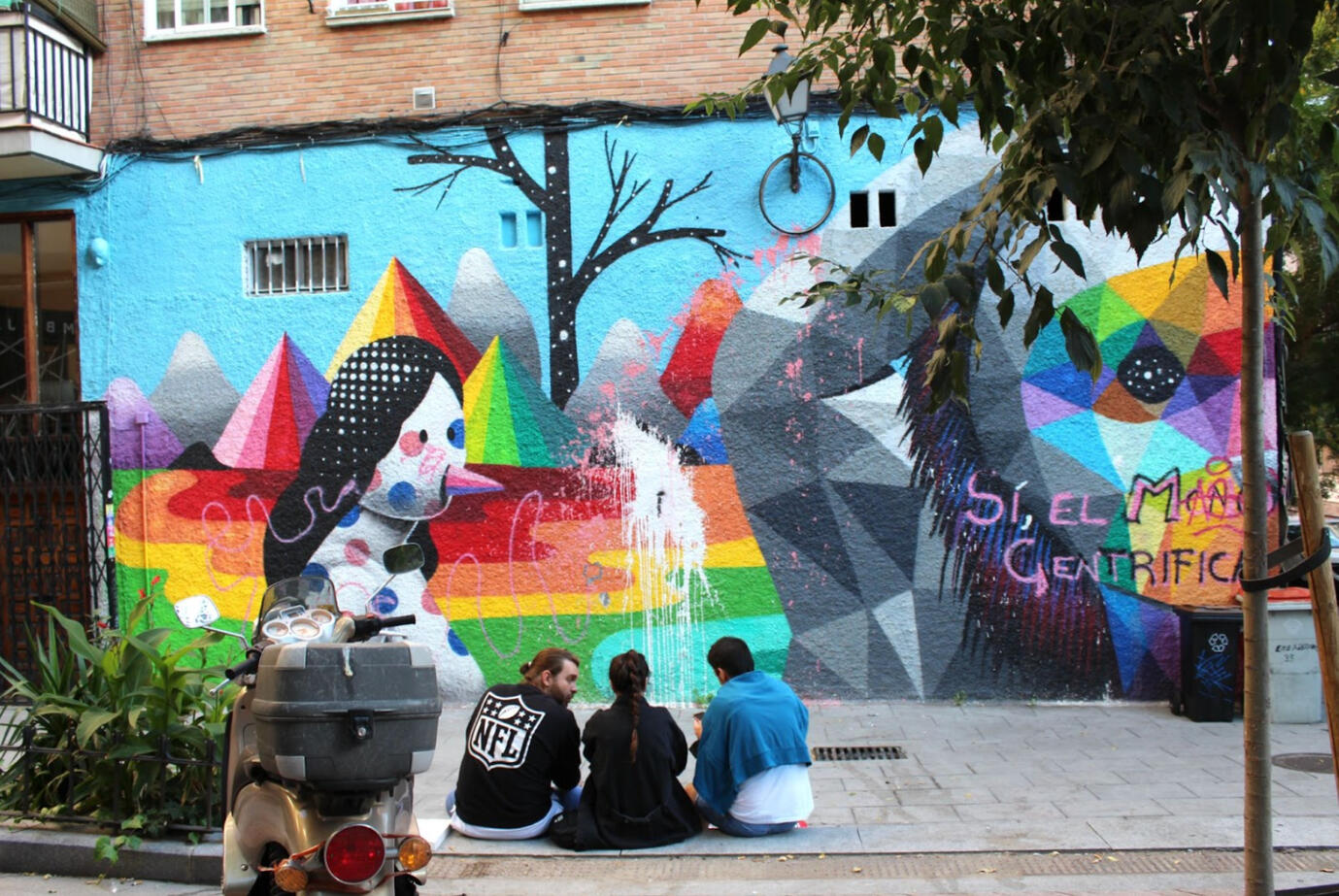
Everyone comes to Madrid with expectations. Madrid, the city that never sleeps, a crossroads of old history and modernity. I have never been a big city person, so everyone told me that studying abroad would be drastic and abrupt. But Madrid is no New York City, Chicago, or any other metropolitan capital. It is not uncommon to misunderstand Madrid.The novelty of the big city is this: the dizzying rush of people on Gran Vía’s manicured streets, colossal billboards like walls surrounding you, Paseo del Prado’s stretching promenade of trimmed trees and fountains, Fuencarral’s long assembly of boutiques, and architectural buildings glittering like scales of a fish. The city is enamouring, but what is a city if not its people? Just with a simple stroll, you’ll see that the people of Madrid occupy the streets more than anything, rain or shine. But more than often than not, Madrid is sunny and shining. You’ll see business men and women adorned in their long blazers and patent leather shoes, teenagers and their ears plugged with music, old couples holding each other’s hands, and uniformed children with their rolling backpacks. Car drivers wave their hands with a resigned sigh as more pedestrians cross the street. Bar owners dart their eyes at those who pass by, breaking into a smile upon seeing their regular customers. Toddlers coo at passing dogs, their parents pulling them along when they stumble. Working men lean against unloaded trucks, shoveling lunch from tupperware containers with their grimy gloves. Crowds of teenagers gather outside and buzz with chatter. You will quickly learn that the city and its people have this in common; they are friendly, open, loud, and with little regard for personal space.Out of all the culture shocks that travel articles list, the one that no one ever told me, is that Madrileños walk slowly. You’ll find yourself staring at the backs of people, willing them to speed up their shuffle. I was under the impression that Madrid would have a city hustle, people hurrying to their next destination and an intolerance to idleness. But this relaxed and easy-going pace extends to even their meals. Lunch is much more than a rushed thirty minute affair with a stuffed sandwich. Madrileños take their time, seated out in terrazas, sipping on cañas or cafés, munching on tapas. The socialising habits of Madrileños had been constricted for a long time due to the Covid-19 pandemic, but now they were back with full force. This is more than just a matter of minutes and hours. Quality time with friends and those who are dear to us are a top-held value to the people of Madrid. This value bleeds into every component of their lives, with how they walk, eat, and interact with others. This is the first step to understanding Madrid and its people. With this came the phenomenon of being foreign, yet also being partially assimilated, as if I was wading in quicksand. Despite coming to this understanding, I still couldn’t find the patience in me to walk at the same pace. I side stepped around everyone, weaving through the crowd, and internally huffing at those who took up the whole street while chatting. It felt lonely in a way, as if I was a straggler swimming through a school of fish. Like this, it is easy to be reminded that you are a foreigner trying to stay afloat in an ocean of people.After settling in for about a month, my roommate and I had developed a method similar to bar-hopping that we called “cafe-hopping”. In Spain, the act of bar-hopping and going out for tapas, goes beyond just throwing back beers and nibbling on snacks. It goes back again to spending time with family and friends. Perhaps unconsciously, I was trying to follow along. I was itching to meet new people and make conversation. I was never a coffee person either, but since coming here, I’ve been downing cafe con leches daily. At one of our cafe-hopping stops, my roommate and I ended up in Lavapies, a historic neighborhood known for its international range of restaurants, terraced bars, and Bohemian cafes. We were at Adorado Bar, an open cafe with tiled walls and red lined windows. Potted plants surrounded the perimeter of the cafe. We sat towards the back, where collected vintage plates hung on the walls, drinking our coffee when a group of people stormed in, taking the table next to us. They were speaking Spanish, English, French, and traces of Italian. To our surprise, they turned around and introduced themselves to us as travelers hailing from Switzerland, but had all studied abroad in different countries and were now working to open a language school in Spain. This type of occurrence is normal in this neighborhood. Lavapies attracts many tourists due to its large immigrant population and its humble history. One of the many hotspots in this neighborhood is the Mercado de San Fernando. The market has stalls that sell books, produce, meats, and a variety of cuisines from different countries. I was most enamoured with a quaint bookshop that held books in old milk crates, broken briefcases, and open desk drawers. The shop owner watched as I ran my fingers along the worn book spines. I picked up a thin chapbook of what seemed to be like a collection of classic Spanish poetry, flipping through the faded yellow pages.“Do you want it?” the shop owner asked me.I shook my head and put the book back in its place. I couldn’t read Spanish that well anyways, but I told the man that I would be back after seeing his crestfallen face. As I wandered around Lavapies, I was confronted with myriads of multiculturalism. Bangladeshi and Indian restaurants, Chinese grocery stores, laundromats and travel agencies with different languages written on their glass windows, all lined the narrow and steep lanes. I passed by corralas, a type of housing that was prominent in old Madrid. These corridor houses contain three to four floors with rows of apartments that were and are home to Madrid’s working class. I continued by a frutería, where the store owner, with drooping eyelids like a sleeping dog in summer, shoved a pineapple into a plastic bag. He shushed the bouncing child in front of the counter. “I’ve made a deal to say less as I grow older,” he said with a resigned grumble. The child whined, but the man hushed him again. “Escucha.”Like a bucket of water being poured over me, not all at once, but gradually, like water seeping into my bones, I came to a realization. I had to listen. I had to listen to Madrid and what it had been trying to tell me. To slow down and take it all in. Madrid, a place where the culture is muddled and ever evolving. It is unapologetic in every sense, taking up all the space and time of its people. Like this, I will continue to gaze at the residents watering house plants and hanging laundry on their balconies. I will go back to the bookshop and attempt my hand at Spanish poetry. I will smile at the dogs that trot along the streets and slow down my walk because there’s no hurry. I will continue to be wary and embracing of this new city as I partake in people-watching, listening to fragments of conversation, capturing a sliver of it, and slipping it in my pocket for later use. On the metro, in the streets, in bars and cafes, I will continue to listen to Madrid’s roar and lull, like fish under ice.
Cover Up
Published in MAD Times: Culture Shock, Issue 1 (2021)
It must’ve been middle of August
when they painted over the wall. Now I stare
at what was the ¡Hola Madrid! sign,
the three old women in headscarves
now toothless, smiles blacked out.The tapas bar owner who daydreams
droops on the phone and rolls tobacco
in a crumpled receipt.The street painter who only talks to faces he
draws
presses a palm to the wall as if to remember
contours of skin and muscle.The homeless girl who holds a sign reading
WILL MARRY FOR FOOD
tugs my wrist, ¡Perdón!
Would you like to do a good deed today?Even stray cats who found asylum
too aware of territory rebranded.
They stop and stare
all who pass by the wall.No, they do not look at the new painting.
Instead they squint, as if willing shed
to reveal the eyes of three old women
in headscarves peeking through.

Jet Lag
Published in MAD Times: Culture Shock, Issue 1 (2021)

I’ve been awake for thirty six hours. If you flew from Spain to Portugal, you’d arrive one hour earlier than when you left. Isn’t that like traveling back in time? If I had just one hour to myself, I’d like to return to the Royal Palace. I want to run and jump in the Porcelain Room. To test it out. See if it was really meant to be a playroom. I want to peel a porcelain angel off the walls. Explore the armory. Two mirrors face each other and I want to see how far infinity stretches, walking in neighborhoods I don’t know with sad histories. An old woman says she has too many sons and tries to pickpocket me. Her hands feel but somehow not her own, plucking coins next to half drunk coffee and open zippers. I’d like to come back to the park and go boating and talk to the man who called himself a bird understander, how it makes him empathetic. In my hotel room, we play cards and order room service. I feel like the king dressing for continental breakfast like sneaking out to drink wine and I giggle on the way back.
Gingerly
Published in Generasian Magazine: Roots (2022)
Why does everything good for you taste bad? While some may argue that they genuinely enjoy their pressed celery juice and kale-squash-quinoa-flax seed brownies, I know the truth: you’ve been conditioned to swallow it down, a Stockholm syndrome of sorts. Good for those who can learn to like foods they used to grimace at. That is not me. The one food I could never warm up to? My number one enemy—ginger.Ginger, zingiber officinale, the root of my distress, is tolerable to me in small doses. It’s a staple of Asian cuisine, adding heat and fragrance to countless dishes. Yet throughout my childhood, it managed to overwhelm all of my senses. My parents would constantly force me to consume ginger, claiming that, ‘It’s good for you!’ as if that knowledge took away the stinging in my nose and burning aftertaste in my throat. My mom would steep it in tea and slip it into my favorite foods—and nothing ruins chicken wings more than biting down on a whole piece of ginger instead of bone. My dad even went as far as to pack ginger pieces in plastic wrap and put them in my jacket pockets so that the smell would “keep me warm.”With every piece of raw ginger that they made me gnaw on, my disdain steadily grew. I began refusing to eat ginger, picking out the strips in stir fries and turning my face away from my mom’s boiling tea. Every time I fell sick, my parents would shake their heads and click their tongues.“You’ve been eating too many cold foods. The wind has gotten to you!”This is what you get for not listening to us, they mean. Despite what they tried to preach to me about its healing properties, I’d rather mope in bed for a couple of days than indulge in their ginger gastronomy.My first year of college, I chose to make the dramatic leap of studying abroad. Even with the distance of the ocean separating my parents and me, they still found a way to impose their lectures, particularly through our weekly, sometimes daily, video calls. Remember to wear a hat when you go out! Never drink cold water! Don’t take a shower too late! Never go to sleep with your hair wet! Perhaps they knew their insistence fell on deaf ears, but I didn’t have the heart to reject their smushed-up faces as they tried to both fit into the phone screen.Every adult that I talked to always asked me the same thing. “Did I miss home?” My answer was “No, not really.” Yes, I did miss the familiarity of my own house, but I was thoroughly enjoying my time away from home without my parents hovering over my head. I had not touched a single piece of ginger since living on my own, save for the time I unpacked my luggage. As I patted down the compartments of my luggage, I heard the crinkle of plastic where I stored my socks. I shoved my hand towards the bottom and pulled out from my fleecy folded socks, an air-sealed package of sugar-dusted ginger candy. I stared at the candy and almost wanted to laugh. No, I truly wasn’t homesick at all. And I thought it would stay that way, just like the ginger candy that sat in the back of my cabinets, until one unsuspecting day, I woke up and discovered upon swallowing my own spit that my throat hurt. All the signs were there: my nose sniffly, my skin scalding to the touch, and my eyes perpetually teary.I got hit with a cold, or more precisely, the wind had gotten to me.
I didn’t call my parents, knowing that they would scold me for not taking care of my health. At first, I refused to get out of bed. There was a pesky voice in the back of my head and I didn’t want to listen to it. But as my cold persisted and my stomach grew hollow, I sought out exactly what I had been trying to avoid all this time: I trudged to the grocery store downstairs and bought the smallest knob of ginger I could find.I looked up a gentrified recipe for porridge and made the saddest bowl I had ever tasted. It was bland and watery, not the slightest semblance of my mother’s simmering pot of laboring love. As I munched on clumps of ginger and spit them out, my reflection in the boiling pot lid stared at me. Hearing my parents parrot their beratings would at least fill the silence, but I couldn’t even call them because of the time difference. It was all too quiet and somehow, nursing myself made me feel even sicker.Before I left for college, my aunt pulled me aside at a gathering and gave me the typical going away to college speech. But with this, she also told me, “Your parents will miss you more than you miss them. For the first time, you will meet more people than you have in your lifetime, while they will feel the loss of what has been constant for the past eighteen years.”What she didn’t tell me, was that it would all catch up to me as well. At this moment, as I poured myself a mug of ginger tea and sat in my compact kitchen, trying to warm my hands, I felt their loss and most of all, the bitter cold.When I was a child, before my aversion to ginger developed, my mom would blow on her tea and bring the cup to my lips, whispering in my ear to sip slowly. As the liquid trickled down my throat, carving a searing path as I swallowed, she placed her hand on my stomach. “This is medicine,” she would tell me. “It takes root in your stomach, spreading through your body, all the way to the tips of your fingers, until your ears are hot. This is how you stay warm.”
Ginger Tea RecipeIngredients
One knob of ginger
Water
Honey
One slice of lemonDirections
Peel the ginger and cut into small, thin strips.
In a pot or kettle, boil the water.
When the water reaches a boil, add the ginger strips and continue boiling until fragrant.
In the meantime, cut up as much lemon as you’d like.
Pour the ginger tea in a cup.
Add honey according to your preference.
Add freshly squeezed lemon juice and stir well. Leave the peel in the tea.
Mouthful
Published in Generasian Magazine: Renew (2023)
The only heirloom the boy carries
is one passed in secret.
A story
whispered in face of a waxing moon
and the tide’s plodding.
He practices
retelling it to himself as he spits
water spiral down drain,
mouthing
to his reflection in the kettle’s rondure
and between chews
words fused
into each bite as he swallows. He taunts
half aired whistles,
the neighbor's dog
barking when he walks by. The waves
wail like a jilted lover
as his jaw dislodges
the stone he hurled sinks down his throat.
He still tries to speak,
lips puckered
like a gaping fish as his windpipe clenches.
His spine thrums,
heat spindling
to his ears, to have seen it all, the ills
of his generation
cries unfurled
so when they ask him, he’ll answer
the ocean is at war
with the shore.
And what of the moon? they’ll ask
is it a spoil of war?
A prize?
He’ll shake his head and correct them,
smile and say no,
a casualty.
The tide ebbs at his heels as if to soothe
and he sputters
runs the story
till it’s worn smooth by tongue over teeth
words more tangible
than flesh.
Body of Water
Published in Generasian Magazine: Renew (2023)
We’ve estranged too long
from our smoldering city.
There’s nothing left on this boat
but soggy baguettes
and our salt seeped bones.
All the rats have jumped overboard.
The sullen woman who can’t sit upright
swept away first and the meek man
who uses his son’s violin to warm his feet
now clutches it to his chest.
I wanted to see how it’d all play out,
but I can’t feel betrayed if I believed a lie
to be true. I’ve already diedin practice. I died when I left
my house and in the jungle
when the soldiers pinned me
down. I died last
night to the lull of the ocean.
Now, as if wailing
it heaves under us. I console it
like a child, nothing more to give
but an embrace. I cry along
as the oil lamp flickers and dims.
Tell me, what becomes of the body
after its last ragged exhale
and how a fish head detached
still thumps its tail?
Best Rainy Day Eats in LES
Published in Bite Club: Inside Scoop (2024)
You wake up to the pattering rhythm of raindrops against the window. In the streets, you walk through the wind, puddles seeping into the soles of your shoes. As spring settles in, you find yourself on those wet and brisk days when all you want to do is curl up in bed and have a hot, comforting meal that’ll make you feel like you haven’t traveled far from your bed. Here are three places in LES where you can take cover from the rain and cozy up with food that’ll be sure to warm both your heart and stomach.Raku
342 E 6th St, NY / 48 MacDougal St, NY
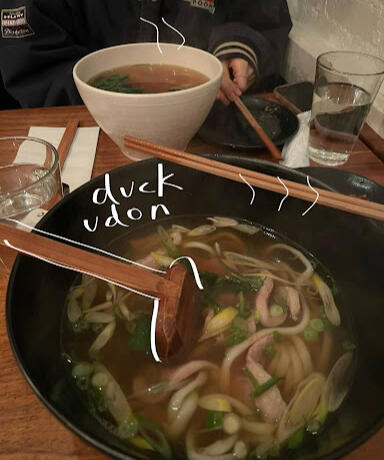
$$Raku is a Japanese hotspot, with two locations in East Village and Soho, specializing in udon noodle soup. The restaurant’s minimalist wooden decor, generous ceramic bowls of broth, and soft, bouncy udon noodles will make you feel right at home. Their broth comes out piping hot, the steam wafting up to warm your cheeks.Try the Nishin (Hokkaido herring) Udon with a poached egg on the side to dip the noodles in; the chewy noodles make a perfect pairing with the silky yolk. If you’re in the mood for something heartier, the Kamonan (duck breast & Tokyo Negi) Udon will hit the spot! At the end of the meal, frozen grapes will always be complimentary, a sweet finish after a nourishing bowl of soup.
B&H Dairy
127 2nd Ave, NY
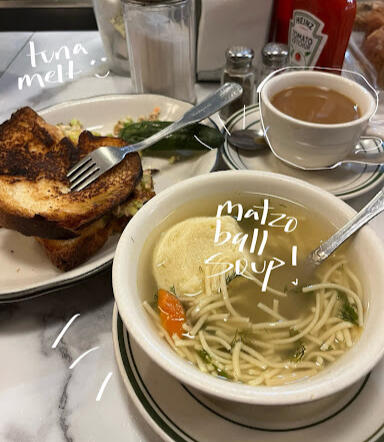
$An East Village staple, B&H Dairy is an old-school kosher diner serving up all the classics. Albeit a bit cramped (like any other NYC restaurant really), you’ll be warmly greeted by staff and met with an extensive menu that has all your favorite nostalgic dishes like their fluffy Challah French Toast and their melty Grilled Cheese.Dig into their Matzo Ball Soup and Tuna Melt at the lunch counter where you can see all the action on the griddle up close. They have a fresh rotation of weekly specials if you’re feeling indecisive or adventurous about your choosing. It’s a humble and no-frills establishment, but the home-cooked quality of the food is perfect on a dreary and chilly day.
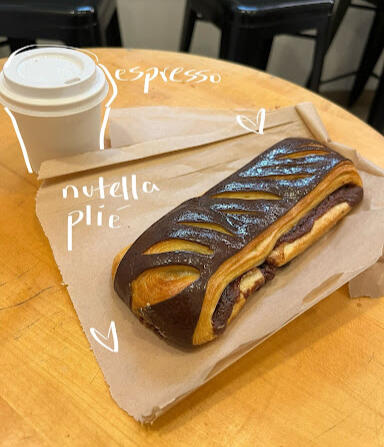
Mille-Feuille Bakery Cafe
552 LaGuardia Pl, NY
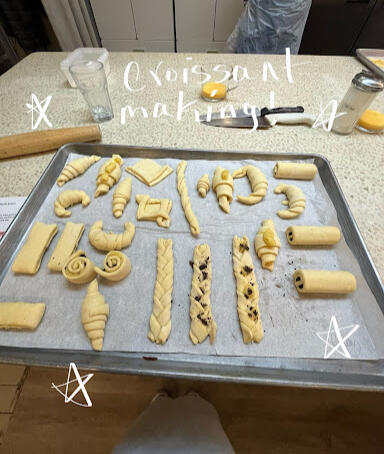
$Tucked right behind Kimmel, you’ll know you’ve stumbled upon this small bakery when met with the old French ladies sitting outside with their headscarves and espressos. When you step into Mille-Feuille, the aroma of freshly baked baguettes and pressed espresso will transport you to a quaint Parisian cafe.Mille-Feuille offers a selection of seasonal pastries, sandwiches, and desserts. Stop by in the afternoon when the morning rush has subsided to study at the counter, table, or bar seats. There’s free wifi and a quieter atmosphere than other bustling cafes. Their almond croissant and daily quiches are always a reliable treat to enjoy in the warmth of the cafe while people-watching or to grab on the go for a quick lunch.Fun fact, Mille-Feuille offers macaron and croissant baking classes, where you can learn their technique and recipe while taking home a stash for yourself! The croissant-making class will instruct the different variations of the croissant, starting from laminating the dough, rolling out and shaping the pastries, to proofing and baking the croissants. It’s definitely a labor of love that’ll challenge your baking skills!
Although this is just scratching the surface of the comfort-food scene in the LES, these are three options that are affordable and emulative of the home kitchen in all its different forms, whether it’s the tender atmosphere of Raku, the bustling scene in B&H Dairy, or Mille Feuille’s contemplative ambiance. Hate or love the rain, a warm meal is what everyone needs on a cold day.
Add Me On Beli?: The Crossover Between Reviews and Social Media
Published in Bite Club: Inside Scoop (2025)
“The camera eats first,” we all say in unison, as we hover our phones above our steaming food, alternating between 0.5 for the entire spread, and 2x for the up-close detail picture. Only then when we capture the perfect photo for our food Instagram highlights, are we able to dig in.We’ve mostly seen food photography like this on Instagram, but the visual-centric feed of the app doesn't allow for the same review features as other restaurant review apps like Yelp or OpenTable. This is where we can study the Google Maps to Beli pipeline.Beli is an app that allows users to build restaurant lists organized by where they’ve been, where they want to go, cities, and categorized into cafes, bakeries, bars, etc. Similar to the app Letterboxd, a social review platform for film lovers, users review their experience and are able to share photos, add notes, and recommend their favorite restaurants. With each entry, Beli automatically ranks each restaurant, making the experience easier if you’re indecisive. If you disagree with the ranking, you have the ability to rearrange your lists to your liking.Why do people love Beli so much, especially younger people? (Fun fact: NYU is first on the school leaderboard on Beli—meaning more NYU students use Beli than students at other colleges!)Beli uniquely combines the features of reviewing with aspects of social media, where eating becomes a social activity that can be shared and exchanged with friends. As a result, the review comes to be more than just about the food and the place, but rather the experience itself that becomes personal to the user.

You can see just how creative users get with their reviews, turning them into mini diary entries, reflections, or afterthoughts. They connect it to their personal life and experiences, in ways that are often irrelevant to the critique of the food itself, but all adding to the social aspect of sharing humor.Of course, in standard restaurant reviews, there’s always the connection between the experience and food, for example, the service, the decor, or the ambiance. But in Beli posts, there’s space to add even more details, through playful observations, inner musings, or inside jokes.

Because Beli has the feeling of posting on social media, there’s less of an expectation to be professional or formal about the review. But what separates Beli from other social media apps is the lack of advertisements and sponsored posts. You can only see your friends’ reviews on your feed and therefore your only audience are your own friends. There is no need to posture and the difference in attitude can be seen in the food photo you post on your Instagram story. Users can be more casual and unfiltered in their reviews, leading to reviews that feel more candid. Instead of curated and structured reviews, users write about their raw and honest impressions.
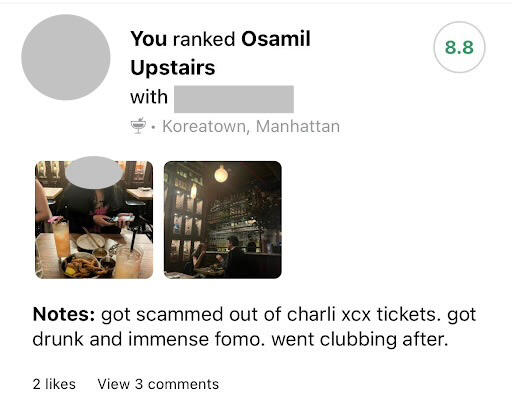
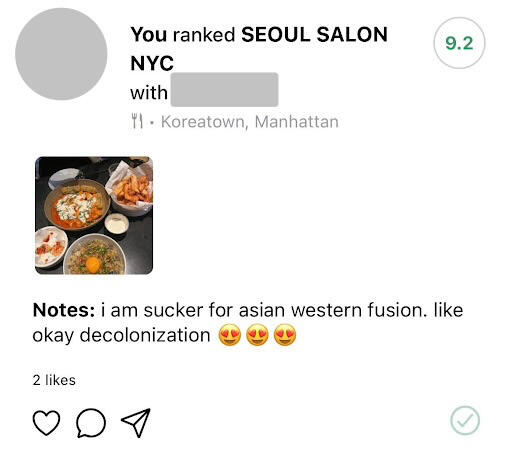
With the feature of tagging friends, liking, and commenting, users write and read reviews in relation to what’s going on in their personal lives. It becomes a way of updating friends because where they’re eating is indicative of what they’re doing in their day-to-day lives. The food becomes a backdrop for casual hangouts, solo dining experiences, travel stories, or important milestones.

Users have a space to write expressive and creative reviews that are both personal and constructive. Friends bond over shared food experiences, whether that’s through consensus or healthy debate. Beli reviews become an archive of the moment, capturing memories that are connected to culinary experiences. The reviews show more than recommendations, merging the reviewer’s personality and experiences with what they’re eating. Food reviews become a way of affirming relationships, memories, and storytelling. And if you don’t know what I’m talking about, when you download the app and spend three hours cataloging every restaurant you’ve visited in the past few years by encyclopedically pinpointing the locations in your camera roll, you’ll understand.